- 39159 Paseo Padre Pkwy STE 115, Fremont, CA 94538, United States
- [email protected]
- +1(510) 250-0510

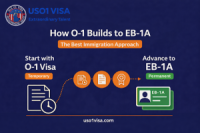
Most people think of the O-1 visa as just a way to work in the United States temporarily. What they do not realize is that every month spent on the O-1 can be quietly building the foundation of something much more permanent — a green card through the EB-1A category.
The O-1 visa and the EB-1A are not two separate roads. For the right professional, they are two stages of the same journey.
Start With the O-1 — Work Now, Build Later
The O-1 visa gets you into the United States quickly. There is no lottery, no annual cap, and no random selection process. If your achievements are strong and your documentation is well-prepared, you can be working in the U.S. within weeks of filing with premium processing.
This is the entry point. But what happens while you are here matters just as much as getting here.
Every year you spend on the O-1 visa is a year you can use to:
- Build a deeper, more documented professional record in the U.S.
- Accumulate media coverage, citations, awards, and industry recognition
- Establish relationships with U.S. employers, collaborators, and institutions
- Strengthen the very evidence that an EB-1A petition will eventually need
The O-1 gives you the platform. The EB-1A is the result of what you do on that platform.
Why the O-1 and EB-1A Evidence Overlap
The EB-1A green card is for individuals with sustained national or international acclaim — the highest standard in employment-based immigration. It sounds intimidating, but here is the key thing to understand: the evidence USCIS looks for in an EB-1A petition is almost identical to what it looks for in an O-1 petition.
Both pathways require proof of things like:
- Awards or prizes in your field
- Media coverage and published material about your work
- Original contributions of major significance
- High salary compared to peers
- Judging or reviewing the work of others
- Critical or leading roles at distinguished organizations
- Recommendation letters from respected experts
The difference is not the type of evidence — it is the depth and duration of it. An O-1 petition can be built on strong recent achievements. An EB-1A petition needs to show that your extraordinary ability is not a moment in time but a sustained pattern over your career.
This is exactly why the O-1 comes first. You use it to enter the U.S., continue working, and keep accumulating the kind of sustained recognition that makes an EB-1A case compelling.
What Changes Between Your O-1 and Your EB-1A
When you eventually move toward an EB-1A petition, you are not starting from scratch. You are upgrading what you already have.
Your evidence gets deeper
The awards you had during your O-1 are still valid. Now you have more of them, or more recent ones, or recognition from a wider set of sources. Your citation count has grown. Your media coverage extends over several years rather than a single moment.
Your U.S. footprint is established
You have worked in the U.S., contributed to U.S. institutions or industries, and built a record of impact that is relevant to American employers, organizations, and audiences. USCIS values this context when evaluating whether your contributions benefit the United States.
Your recommendation letters carry more weight
Letters from recognized U.S.-based professionals who have worked with you or observed your impact firsthand are significantly more powerful than letters written before you arrived. Time on the O-1 gives you the relationships to collect these letters properly.
You can self-petition
One of the most important differences between the O-1 and the EB-1A is that the EB-1A allows you to file the petition yourself, without needing an employer or agent. After building your U.S. career on the O-1, you have the independence to pursue permanent residency entirely on your own terms.
The Timeline Most Professionals Follow
There is no single required timeline, but here is the path that works well for most extraordinary professionals:
- Apply for the O-1 visa once your profile meets the criteria and your documentation is well-organized.
- Enter the U.S. and begin working in your field under O-1 status.
- Continue building your professional record — new awards, press, contributions, publications, or business milestones.
- Begin preparing your EB-1A documentation after 1 to 2 years, while still on O-1 status.
- File the EB-1A self-petition while maintaining your O-1 status so there is no gap in your work authorization.
- Upon EB-1A approval, adjust your status or go through consular processing to receive your green card.
You do not have to rush. The O-1 can be extended in one-year increments indefinitely as long as your work continues. This flexibility is what makes it such a powerful bridge toward permanent residency.
Who This Path Works Best For
The O-1 to EB-1A pathway is particularly well-suited for:
- Professionals from countries with long green card backlogs like India or China, where EB-2 and EB-3 waits can stretch decades — the EB-1A has a separate, faster-moving queue
- Startup founders and entrepreneurs who are building something in the U.S. and need time to establish the track record required for the EB-1A
- Researchers and scientists who are accumulating citations, publications, and grant recognition over time
- Artists, filmmakers, and creative professionals whose careers grow through sustained exposure and critical recognition rather than a single achievement
- Anyone who wants a permanent residency path that does not depend on employer sponsorship or a labor market test
How USO1 Visa Supports This Journey
At USO1 Visa, we work with professionals at both stages of this path. Whether you are preparing your first O-1 petition or beginning to think about what an EB-1A case would look like based on your current profile, we help you organize your documentation and understand where you stand.
Our team helps with:
- O-1 profile evaluation and evidence organization
- Structuring your petition support documents to align with USCIS standards
- Identifying which of your achievements are strongest and which areas need further development
- Preparing documentation that serves the O-1 now and lays the groundwork for the EB-1A later
- RFE response support if USCIS requests additional evidence
We are not attorneys and we do not provide legal advice. For legal strategy and petition filing, you should work with a licensed U.S. immigration attorney. What we do is make sure your achievements are documented, organized, and presented as clearly and compellingly as possible.
Conclusion
The O-1 visa is not just a way to work in the United States. For the right professional, it is the beginning of a well-planned journey toward permanent residency.
Every achievement you build on the O-1 is an achievement that strengthens your future EB-1A case. Every year of recognized, documented, impactful work in the U.S. is a year that moves you closer to a green card that belongs to you permanently — with no employer dependency, no lottery, and no cap.
If you are extraordinary at what you do, the United States has a path built for people like you. The O-1 visa is where that path begins.
Get a Free O-1 Profile Evaluation at uso1visa.com
Disclaimer: USO1 Visa is not a law firm and does not provide legal advice. All content is for informational and educational purposes only. For legal guidance specific to your case, please consult a licensed U.S. immigration attorney.